The Small-Bag Strategy: How to Shop Shinbashi Candy Counters by the Gram
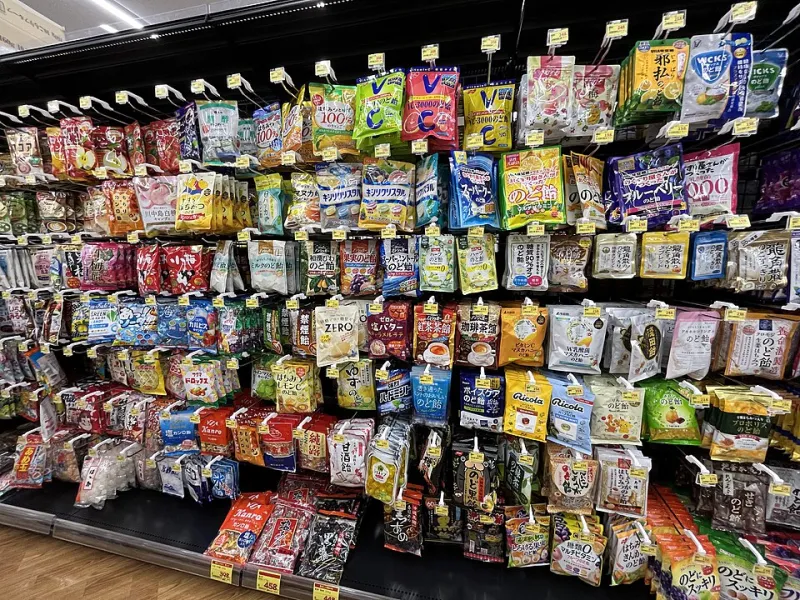
Photo: LittleT889, CC BY 4.0, via Wikimedia Commons
Walk into the right Shinbashi candy shop and you will not always be handed a glossy package with a barcode. You will see bins, scoops, a small scale, and a price card that says something like 280 yen per 100 grams. That number is the key to the whole experience. It is not the price of a bag, and it is not a dare. It is a unit price, and once you learn to read it, you can build a candy bag that feels less like an impulse grab and more like a tiny curated snack shop.
Start With the Unit Price, Not the Scoop
Per-100-gram pricing is common in old-school candy shops, and it rewards a little math. A candy that costs 300 yen per 100 grams sounds expensive until you realize that a small handful might weigh only 40 or 50 grams. That puts the actual cost closer to 120 or 150 yen. The trick is to think in 50-gram units. Half a unit, one unit, two units. Most small paper bags hold somewhere between 150 and 300 grams, so a modest mix can still include five or six different candies.
Before you start scooping, ask the staff for a small bag and watch whether they tare the scale. Good shops do this automatically. If the scale is not cleared, the bag itself is riding along in the price. You do not need to make a speech about it. A simple sumimasen and a gesture toward the scale is enough. In Shinbashi, counter staff are used to customers who want to try a little of this and a little of that.
Give Every Candy a Job
A good custom bag is not a random assortment. It is a small team with different roles. Hard candies are the backbone: they last, they do not crush, and they give you something to suck on during a train ride or a long walk. Chewy candies add contrast, but they also need wrappers and a little space so they do not fuse into one giant mass. Sembei, the savory rice crackers that show up in many Japanese snack shops, bring salt and crunch. A few wrapped chocolates or seasonal items can be the wildcard.
If you fill the bag with only one texture, you will get bored halfway through. A bag of only hard candy is efficient but one-note. A bag of only chews turns into a jaw workout. The pleasure of buying by weight is the permission to mix, and the mix is what makes the bag feel personal.
The 40/30/20/10 Starting Ratio
For a first custom bag, try a rough ratio: 40 percent hard candy, 30 percent chews, 20 percent sembei, and 10 percent wildcard. That is not a rule written on a shop wall. It is a practical starting point that keeps the bag interesting without letting any one texture take over.
In a 250-gram bag, that looks like about 100 grams of hard candy, 75 grams of chews, 50 grams of sembei, and 25 grams of something unusual. You might choose a citrus hard candy, a milky chew, a soy-glazed rice cracker, and a few individually wrapped seasonal sweets. The exact picks matter less than the balance. If you hate chewy candy, flip the ratio. If you are buying for a desk drawer, lean harder on hard candy. The point is to decide before you scoop.
Weigh as You Go
Do not fill the bag and then discover that your eyes were much bigger than your budget. Scoop a little, weigh, and adjust. Most shops are relaxed about this. The scale is there for a reason, and a small bag is easier to manage than a giant one. If you are buying sembei, ask for it to be bagged separately or place it near the top of your bag so it does not get crushed by heavier candies.
It also helps to snap a photo of the bin labels as you go. Shinbashi candy shops often carry unfamiliar names, and by the time you get home, the difference between two similar-looking amber candies will be a mystery. A quick phone photo of the label and the price card is a low-effort way to remember what you bought. No one at the counter will mind.
A First-Timer's 250-Gram Bag
Here is a sample mix that works for a US traveler who wants variety without a suitcase full of sweets. Start with 100 grams of hard candy, preferably two flavors rather than five. Add 75 grams of wrapped chews, choosing one fruity and one milky type. Add 50 grams of sembei, ideally in a small separate bag. Finish with 25 grams of a wildcard: a seasonal candy, a sesame sweet, or a softly wrapped chocolate.
At many Shinbashi shops, a bag like this lands somewhere in the 700 to 1,200 yen range depending on what you choose. That is often less than a fancy coffee and pastry in a US city, and it gives you a much wider range of tastes. The bag is small enough to finish, which matters. Candy that sits in a cupboard for a year is not a bargain, even if it was cheap.
Packing It for the Trip Home
Hard candy is forgiving. Chews can flatten under weight. Sembei cracks if it is tossed into a backpack with a water bottle. For the trip home, double-bag the whole mix and keep the sembei in a small rigid container or at the top of your carry-on. Avoid leaving the bag in a hot car or a checked suitcase that will sit on a tarmac. Individually wrapped candies are generally easier to pack and share, and US travelers should check current customs rules for any food items they bring back.
Why the Gram Approach Works
Buying by weight is an old-school pleasure that fits modern snack habits. It lets you try a little of something strange without committing to a full package. It lets you build a gift bag that looks thoughtful rather than expensive. And it turns a candy counter into a place to make decisions instead of simply grab. In Shinbashi, where small shops and commuter traffic sit side by side, that little bag of mixed sweets is a practical souvenir: light, personal, and easy to finish before the novelty wears off.