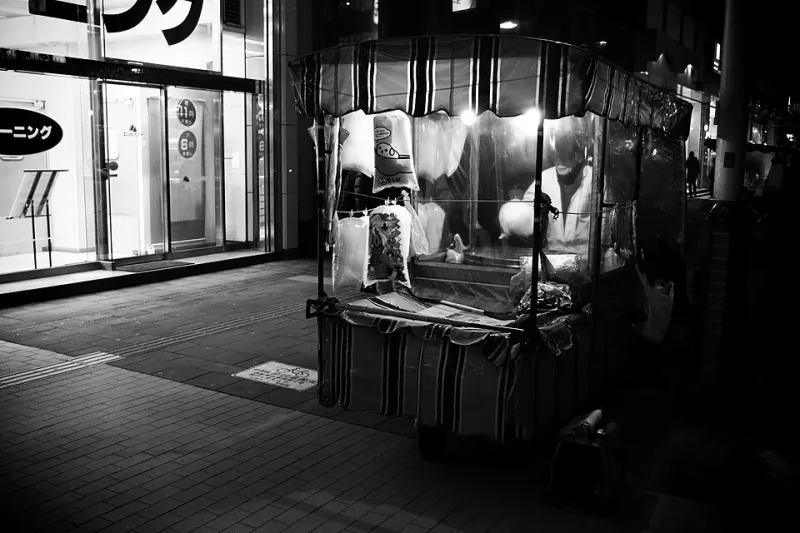
Hot Sugar, Steady Hands: The Quiet Revival of Amezaiku in Shinbashi
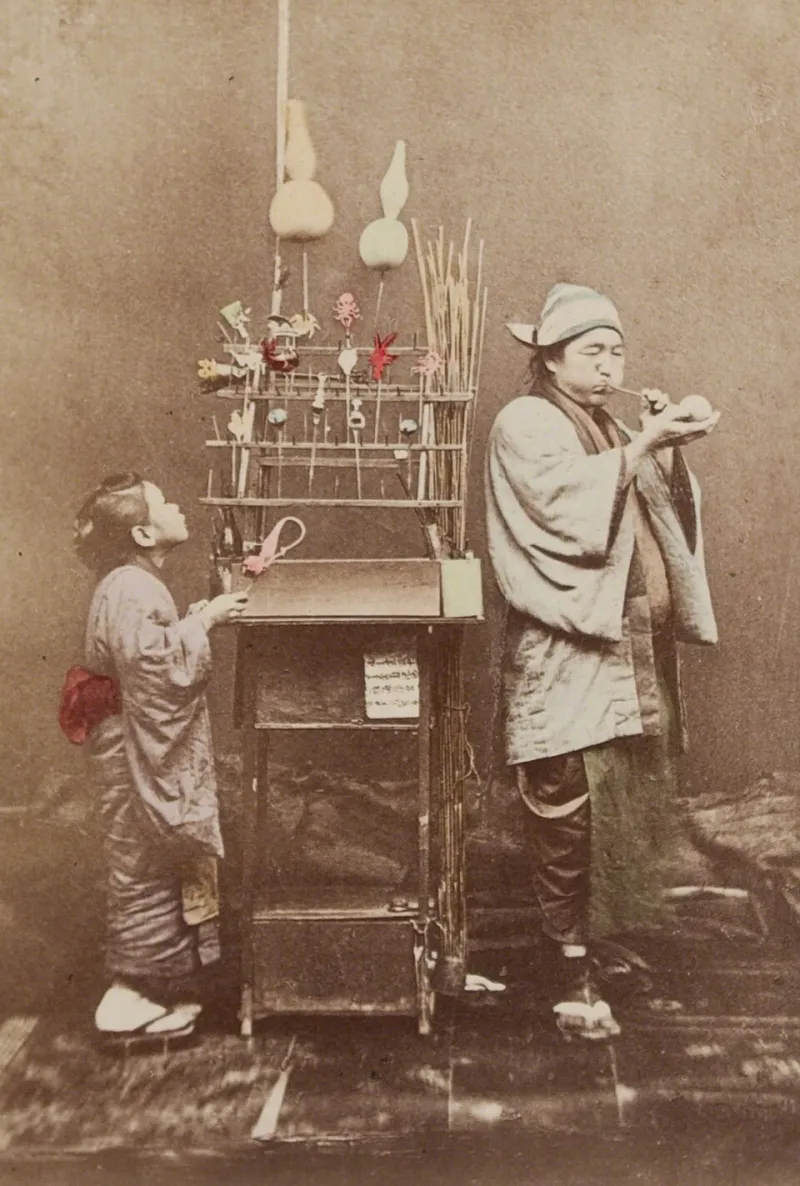
Photo: Museum of Photographic Arts Collections, No restrictions, via Wikimedia Commons
The first thing you notice is the smell: caramel, but sharper, almost singed. The second thing is the sound, a small steel click every few seconds, like someone trimming a bonsai. A dozen people are crowded around a counter no wider than a kitchen table, phones half-raised, watching a pair of hands work a lump of sugar that is too hot to touch for more than a few seconds at a time.
This is amezaiku, and in 2026 it has become one of the most photographed crafts in Tokyo.
What Amezaiku Actually Is
The craft is simple to describe and almost impossible to do. Sugar and starch syrup are cooked into a firm, pliable candy, tinted, warmed until it behaves like soft taffy, and then pulled, pinched, and cut into a shape — a goldfish with a translucent tail, a rabbit, a crane, a dragon — before the sugar cools and sets. The working window is short. Three minutes, give or take, and the material goes from sculpture to stone.
There are no molds in the traditional method. The artisan uses warm fingers for the big forms and small scissors for the details: fins, ears, the curl of a tail. Some modern makers use air pumps or silicone molds for volume production, but the pieces people stop to watch are still made by hand at a counter, one at a time.
There is historical argument about where the craft first took hold, but it was well established in Edo-period Tokyo as a street performance — candy as theater, sold to crowds who wanted to see the making as much as the eating. In the twentieth century it thinned out, squeezed by wartime sugar rationing and then by the general drift of street trades indoors. What survived did so in a handful of shops and at festival stalls.
Why It's Everywhere Again
Amezaiku is unusually well suited to short video. The transformation is instant and legible: a blob becomes an animal in real time, with no cuts. The colors are saturated, the hands move fast, and the payoff is a finished object that looks like glass but is food. It's the same reason glassblowing clips travel — process, compressed.
But social media alone doesn't explain the line outside a Shinbashi workshop on a Tuesday. The bigger factor is that Japan's inbound tourism has shifted toward experiential purchases. Travelers who have already bought the fridge magnet and the train-themed keychain are looking for something that requires them to stand still for five minutes. A demonstration offers exactly that: a seat, a story, and a souvenir you can't buy at the airport.
What's changed in 2026 is supply. Workshops now run timed sessions rather than open counters, partly to manage crowds and partly because a crowd of thirty people with phones changes the temperature of a small room. Several Shinbashi-area makers have added English-language signage and card payments, and a few offer short hands-on sessions where you attempt a very simple shape under supervision. Expect to fail. That's the point.
What the Artisans Are Actually Doing
Talk to anyone who has done this for a decade and the craft is described less as art and more as a negotiation with heat. The sugar is worked at a temperature that is unpleasant but not dangerous to an experienced hand, and the timing is learned in the body rather than the head. A first-time student usually produces something lumpy within twenty seconds; a veteran produces a heron with a lifted leg.
Most of the Shinbashi-area makers are small operations — one or two people, a counter, a display case, a small box of finished pieces. Many also sell a handful of related sweets to keep the lights on: hard candy, lollipops, seasonal shapes. The economics are not glamorous. A single sculpted piece might sell for the price of two coffees, and each one takes minutes of skilled labor plus the risk of cracking.
That fragility is part of the appeal. Amezaiku is not engineered for shipping. It is engineered to be looked at, briefly admired, and eaten — ideally within a day or two.
How to Watch Without Being That Tourist
A few courtesies go a long way, and most makers are genuinely happy to be filmed if you ask first.
- Ask before you film. A gesture toward your phone and a raised eyebrow works in any language.
- Turn off the flash. It's distracting at close range and the lighting is usually already set for the work.
- Don't lean over the counter. The sugar is hot and the working space is small.
- Keep kids behind the line. Makers are watching their hands, not your toddler.
- Buy something. If you've watched a full demonstration, a purchase is the polite version of a ticket.
- Skip the tip. It isn't customary in Japan and can cause mild awkwardness.
- Go early. Mid-morning crowds are thinner and the light is better.
Getting One Home in One Piece
This is where most visitors learn a hard lesson. Amezaiku is essentially sugar glass — beautiful, brittle, and deeply unhappy about humidity.
- Ask for a rigid box. Many shops provide one; a paper bag is not enough.
- Keep it cool and dry. Not in a hot car, not next to a water bottle, not in a bathroom.
- Carry it on the plane. Checked baggage is a compression experiment you will lose.
- Don't expect it to last. A week at most in cool conditions, less in a humid apartment.
- US customs: finished, commercially made candy is generally admissible for personal use, but declare food items if an officer asks. Avoid anything with a fresh-fruit filling.
The Case for the Fragile Souvenir
Amezaiku is a strange thing to buy. It costs more than a snack, lasts less than a week, and breaks if you look at it wrong. And yet the people who carry one home from Shinbashi tend to remember it longer than anything else in their suitcase.
Maybe that's because it's the opposite of a souvenir that sits on a shelf forever. It's a record of five minutes you stood still and watched somebody's hands do something you'll never be able to do. Then, eventually, you eat it — and the caramel smell comes back.